Mumbai eats on the street. Not as a novelty or a tourist thing, but because that is how a city of twenty million feeds itself between one place and the next. The food is fast, cheap and, if you pick sensibly, safe.
This is what to eat, where, and how not to spend your third day in a hotel bathroom.
The rules that actually matter
Most street food advice is either paranoid or reckless. Here is the version we give our own guests.
- Eat where there is a queue. High turnover means fresh food and nothing sitting around. An empty stall at lunchtime is empty for a reason.
- Watch it being cooked. Anything that goes into hot oil in front of you is fine.
- Be careful with water-based items on day one. Pani puri is delicious and worth having. Have it once your stomach has settled, or at a stall your guide knows.
- Skip pre-cut fruit from carts, and anything that has been sitting uncovered.
- Carry hand sanitiser. Most street food is eaten with your hands.
- Start slowly. Do not eat twelve dishes on your first evening.
Vada pav, the one to start with
A spiced mashed potato ball, dipped in gram flour batter, deep fried, and served in a soft bread roll with dry garlic chutney. Around 20 rupees.
Often called the Mumbai burger, which undersells it. It is the working city’s default lunch, sold from thousands of stalls, and no two make it quite the same. Ask for it with fried green chilli if you can take heat.
Pav bhaji
A thick mashed vegetable curry cooked down on a flat griddle with an unreasonable amount of butter, served with buttered bread rolls and raw onion. It was invented in Mumbai in the 1850s as a quick meal for textile mill workers.
Best eaten at a stall where you can watch it being worked on the griddle.
Pani puri
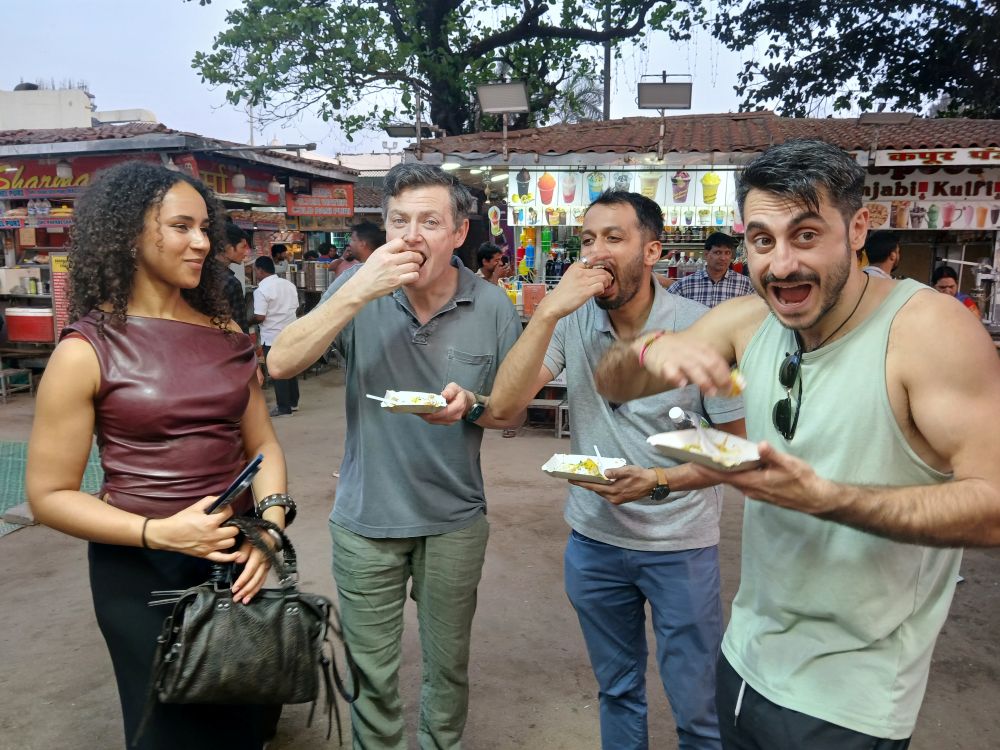
Hollow crisp shells filled with spiced water, tamarind, potato and chickpea. The whole thing goes in your mouth in one go. There is no dignified way to eat it and nobody expects you to find one.
The vendor hands them to you one at a time and keeps going until you signal stop. Most first-timers manage six. It is a small competition and everyone joins in.
Bhel puri and sev puri
Bhel puri is puffed rice tossed with onion, tomato, tamarind and coriander, assembled in front of you in about forty seconds. Light and sharp.
Sev puri is flat crisp discs topped with potato, chutneys and a heap of fine gram flour noodles. Both are best on Chowpatty beach at sunset, which is where Mumbai eats them.
Baida roti and kebabs
This is where Mohammed Ali Road comes in, particularly during Ramadan when the street stays open half the night.
Baida roti is a thin dough parcel filled with spiced minced meat and egg, fried flat on a griddle. Seekh kebabs come straight off the coals. This is the meat-eating half of Mumbai street food and it is very good.
Misal pav
Sprouted moth beans in a fiery curry, topped with farsan, onion and coriander, with bread to mop it up. A Maharashtrian breakfast, genuinely spicy, and the dish locals are most surprised to see visitors order.
Frankie and Bombay sandwich
The Frankie is a Mumbai invention from the 1960s: a paratha wrap with spiced filling and a tangy masala. The Bombay sandwich is white bread, green chutney, cucumber, tomato, beetroot and boiled potato, sometimes pressed and covered in cheese. Both are unglamorous and both are excellent.
Falooda and kulfi
Falooda is rose syrup, vermicelli, basil seeds, milk and ice cream in a tall glass. Kulfi is denser and less sweet than ice cream, usually pistachio or malai.
For hand-churned fruit ice cream, Taj Ice Cream in Bohri Mohalla has been making it the same way since the 1880s. Seasonal fruit, no machines, no shortcuts.
Cutting chai
Half a glass of strong milky tea, sold everywhere for about ten rupees. “Cutting” because it is cut in half, meant to be drunk quickly standing at the stall. You will have four a day without noticing.
Where to go
Girgaon Chowpatty after 6pm for beach snacks: bhel, sev puri, pani puri, kulfi.
Mohammed Ali Road in the evening for meat, kebabs and baida roti.
Bhuleshwar and the market lanes for snacks between shops.
Anywhere near a station at 8am for vada pav, which is where the city actually eats it.
Vegetarian and dietary notes
Mumbai is one of the easiest cities in the world to eat vegetarian. A large share of street food is vegetarian by default, and stalls are usually clearly one or the other.
Vegan is harder, because ghee and butter appear in a lot of it. Say “no butter, no ghee” and most vendors will manage.
Jain food without onion or garlic is widely available and understood.
Gluten is difficult, since most snacks involve bread or wheat.
What it costs
Most items are 20 to 80 rupees. A serious evening of eating across six or seven dishes comes to a few hundred rupees a person. Street food is the cheapest good food in the city by a wide margin.
Eating with a guide
You can do all of this alone, and you should try. What a guide adds is knowing which of four identical-looking stalls is the one locals use, and being able to ask for things that are not written down anywhere.
Our Street Food and Evening Bazaar Tour covers up to ten dishes across Chowpatty, the market lanes, Mohammed Ali Road and Taj Ice Cream. Come hungry and do not eat lunch.
Now you know what to order, here is where to eat street food in Mumbai, area by area.