Every working day in Mumbai, around 200,000 home-cooked lunches are collected from houses across the city, carried by train and bicycle through one of the densest urban areas on earth, and delivered to the right desk before one o’clock. The empty tins then go back the same way.
There are no computers involved. Most of the men who do it have limited formal schooling. And the system almost never gets it wrong.
This is the dabbawala network, and it is one of the more remarkable things happening in Mumbai on any given Tuesday.
What is a dabbawala?
Dabba means box, in this case the stacked steel tiffin carrier that Indian lunches travel in. Wala means the person who does the thing. So a dabbawala is, quite literally, a box person.
The network began in 1890, when a Parsi banker wanted home food at his office and hired someone to fetch it. Others wanted the same. By the 1950s it was an organised cooperative. Today around 5,000 dabbawalas serve the city, and the organisation is owned by the men who work in it.
How the system actually works
The lunch is cooked at home in the late morning, usually by a wife or mother, sometimes by a small kitchen. A dabbawala collects it from the door between 9 and 10am.
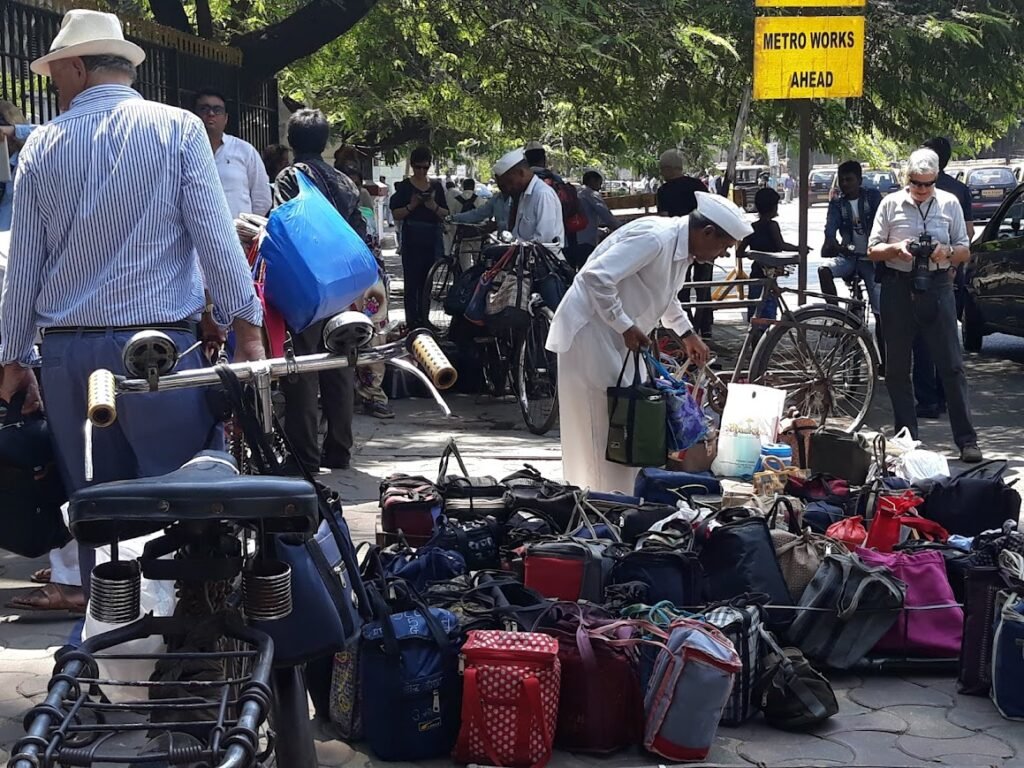
He takes twenty or thirty tins by bicycle to the nearest railway station. There the tins are sorted onto wooden crates by destination, and loaded onto the luggage compartment of a suburban train.
At the destination station they are sorted again, handed to a different dabbawala, and taken by handcart or bicycle to the office. The tin reaches the desk before lunch. In the afternoon the whole chain runs in reverse.
Each tin is handled by three or four different men and travels perhaps 60 kilometres. Nobody signs for anything.
The code on the lid
The whole thing runs on a short code painted on the lid. It is not an address. It is a compressed set of instructions, usually a mix of colours, numbers and letters.
Broadly, it records the originating suburb, the destination station, the building, and the floor. A dabbawala who cannot read a written address can read this in a second, because the system uses symbols and position rather than words.
That design choice is the reason it works. Literacy is not a requirement. Pattern recognition is.
How accurate is it really?
You will often read that the dabbawalas achieve a Six Sigma error rate, roughly one mistake in six million deliveries. That figure comes from a magazine article and has never been independently audited, so treat it with some caution.
What is not in doubt is that errors are rare enough that regular customers stop thinking about it. Forbes and the Harvard Business School have both studied the network, and Prince Charles visited in 2003 and again in 2005. The dabbawalas were invited to his wedding.
The more interesting point is not the number. It is that a system with no technology, run by men on bicycles, is more reliable than most logistics operations with warehouses full of software.
Why it has survived
Food delivery apps arrived in Mumbai a decade ago and were supposed to end all this. They did not, for three reasons.
The food is different. A dabba is home cooking, made by your family, to your diet, at your spice level. An app delivers restaurant food. They are not competing for the same meal.
The price is different. A monthly dabba subscription costs roughly what two restaurant deliveries cost.
Trust. Many customers have used the same dabbawala for twenty years. He knows the building, the lift, the security guard and the desk.
The network has adapted rather than resisted. Many now take orders by WhatsApp and some accept UPI payments. The trains and bicycles have not changed.
Where to see the dabbawalas
The best moment is the sorting, which happens on station platforms in the late morning. Churchgate and Chhatrapati Shivaji Maharaj Terminus are the main arrival points in South Mumbai, and the sorting happens roughly between 11:20am and 12:30pm.
It is fast, loud and completely unceremonious. Crates come off the train, men call out codes, tins move between hands, and within fifteen minutes the platform is empty again.
If you go alone, stand well back. This is work, not a display, and the men are on a deadline. Do not block the flow, and ask before photographing anyone.
What to know: the dabbawalas do not operate on Sundays or public holidays, and the network pauses during some festivals. Timings shift, so check before making a special trip.
Seeing it with a guide
Watching the sorting is interesting. Understanding it is better, and that needs someone who can explain the code, tell you which man is doing what, and introduce you rather than leaving you standing awkwardly at the edge.
Our Public Transport and Dabbawala Tour covers the sorting alongside the wider system that makes it possible: a city bus to Victoria Terminus, a suburban train to Dadar junction, the flower market, the Dhobi Ghat viewing point and Chor Bazaar. Three hours, and it explains how twenty million people actually move around this city.
Common questions
Can I order a dabba as a visitor?
Not practically. The service works on monthly subscriptions to a fixed address, and it collects from a home kitchen. It is not set up for short stays.
How much do dabbawalas earn?
Roughly 15,000 to 20,000 rupees a month. The cooperative structure means each man is a shareholder rather than an employee, and earnings are shared within his group.
Are there women dabbawalas?
Very few. It has historically been men, mostly from villages near Pune, often related to each other. That is slowly changing.
What happens if a tin goes missing?
It is traced back through the chain, because each man knows who handed him what. Missing tins are rare and usually turn up the same day.
Is it worth seeing?
If you find systems interesting, yes. If you want a photogenic monument, no. This is fifteen minutes of intense, unglamorous work that happens to be one of the most efficient supply chains anywhere.
Mumbai is full of things that should not work and do. The dabbawalas are the clearest example, and they have been proving it for over a century.
New to the system? See our guide to Mumbai local trains.